Ulrich Tränkle & Friederike Hübner
1. Original description
Trichocaulon flavum N. E. Brown, J. Linn. Soc. 17: 165, t. 11. 1878
2. Synonyms
Trichocaulon karasmontanum Dinter, Repert. Spec. Nov. Regni Veg. 24: 16. 1927
3. Description
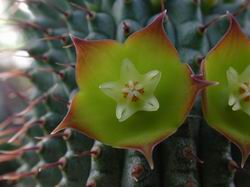
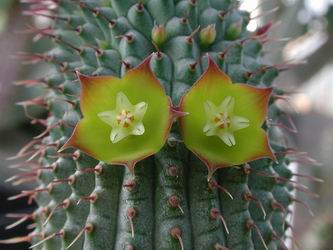
Body: shrub up to 30 × 50 cm, usually smaller, branching from the base; stems grey-green, upright, up to 50 cm long and 2–7 cm thick. Ribs: tubercles arranged in 18–31 ribs, each tubercle ending in a light- to dark-brown spine 4–6 mm long. Flowers: in groups of 1–3, mainly in the upper part of the stem. Pedicel: 0.5–1 mm. Sepals: 2.5–3.0 mm long, glabrous, 1–1.5 mm wide at the base, pointed and appressed to the corolla.
Corolla: 1.1–1.3 cm in diameter, divided to about halfway, glabrous on both surfaces; outside smooth, inside covered with small papillae that may end in fine hairs or may be smooth. Corolla tube absent; flower flat to slightly cup-shaped with a shallow depression around the gynostegium. Colour greenish yellow, greenish yellow with brown tips, or entirely brown. Corolla lobes oval-triangular, abruptly pointed, spreading, 2.5–4 × 3.5–5.0 mm. Corona: yellow, rarely translucent brown. Outer corona (interstaminal corona) spreading, 1.6–2.2 mm long, divided below the middle into two delicate, flattened horns, with the outer horns converging. Inner corona (staminal corona) 0.6–1 mm long, linear, blunt and flattened, lying on the anthers, shorter or longer than them and sometimes meeting in the centre. Fruit: follicle, usually two, 75–180 mm long, with 55–105 seeds per pair.
Description after Bruyns, P. V. (1993): A revision of Hoodia and Lavrania (Asclepiadaceae - Stapeliae). Bot. Jahrb. Syst. 115(2): 145–270.
4. Distribution
From the eastern and southern slopes of the Great Karas Mountains in Namibia, through the Cape region and east of the winter-rainfall area around Pella and Pofadder (Bushmanland), to Prince Albert and near Rietbron on the southern margin of the Great Karoo.
5. Cultivation
Hoodia flava prefers a purely mineral, loose and well-drained substrate, apparently especially acidic mixtures. Stagnant heat and full sun at high temperatures rapidly cause shoot tips to dry out and scorch. Waterlogging and high humidity, particularly at temperatures below 10–15 °C, should be avoided, although the species is not exceptionally susceptible to fungal infection. Re-rooting requires patience and care and is best carried out in pure quartz sand or Seramis in partial shade with cautious but consistent watering. The risk of further rot is high. Overwintering at about ±10 °C is possible; somewhat higher temperatures, for example on a suspended shelf, are also suitable. Grafting onto Ceropegia woodii has proved very successful and produces freely flowering plants. Propagation is best from seed or by grafting offsets.
6. Notes
H. flava is relatively undemanding, remains comparatively compact for many years and can flower throughout the year. Plants begin to flower at an age of two to four years. True-to-species seed is still very difficult to obtain. Although the species has become somewhat more frequent in collections in recent years, it remains rare. With some practice, hand pollination is straightforward. Spontaneous fruit set is not known. Natural hybrids have not been documented, although some very attractive hybrids occur in cultivation.
Following the revision of Hoodia and Lavrania by Bruyns (1993), H. flava was transferred from Trichocaulon to Hoodia sect. Trichocaulon.