Ulrich Tränkle & Friederike Hübner
1. Original description
Trichocaulon officinale N. E. Brown, Bull. Misc. Inform. 1895: 264. 1895
2. Synonyms
Trichocaulon pubiflorum Dinter, Repert. Spec. Nov. Regni Veg. 30: 192. 1932
Trichocaulon rusticum N. E. Brown, Fl. Cape 4 (1): 891. 1909
3. Description
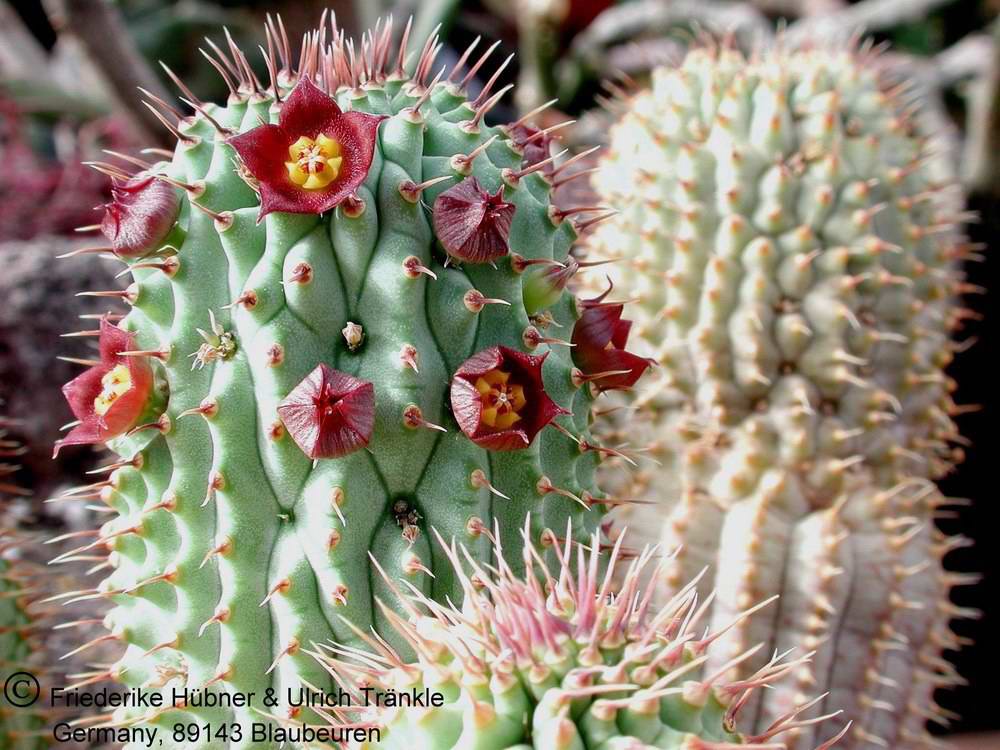
Body: small shrub up to 30 × 50 cm, usually smaller, branching from the base; stems grey-green, upright, up to 50 cm long and 3.5–6.5 cm thick. Ribs: tubercles arranged in 17–22 ribs, each ending in a dark brown spine about 6 mm long.
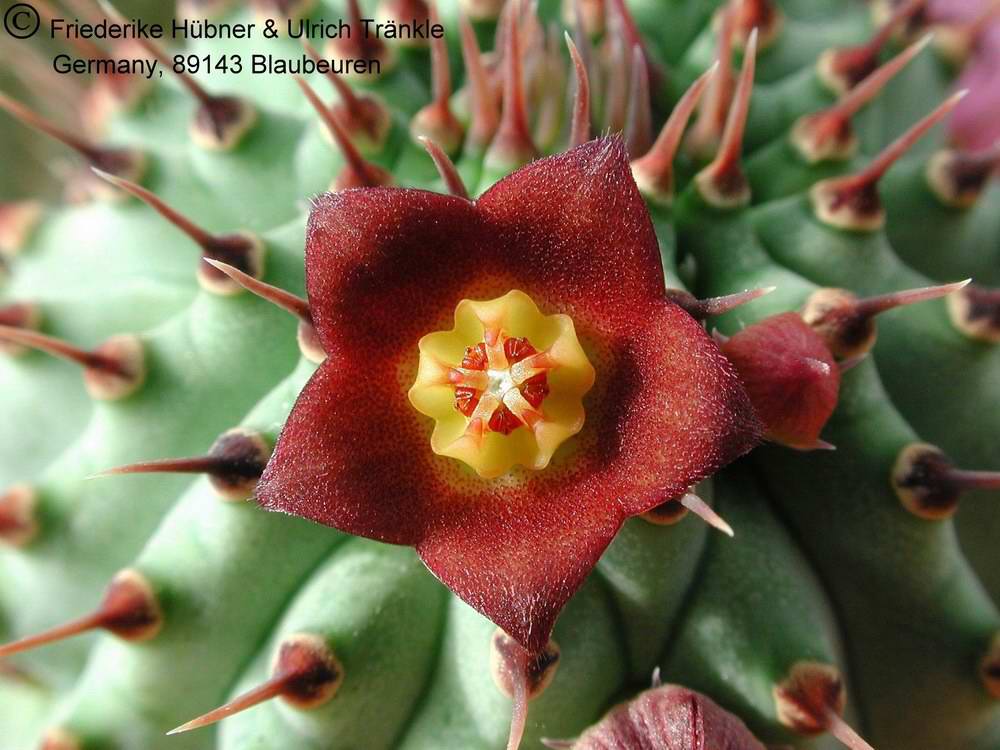
Flowers: in groups of 1–3, mainly in the upper part of the stem. Pedicel: <1 mm. Sepals: 2.5–3.5 mm long, smooth, ovate-lanceolate and pointed. Corolla: 1.0–1.4 cm in diameter, flat to slightly bell-shaped with a broad saucer-shaped tube; outside glabrous and smooth, inside covered with small papillae ending in fine hairs. Colour red- to yellow-brown inside, paler centrally; outside greenish with brownish stripes. Corolla lobes oval-triangular, pointed, spreading with recurved tips, 3–5 mm long and 3.5–5.5 mm wide at the base. Corona: outer corona usually yellow, sometimes finely dotted red; inner corona brownish, about 4 mm in diameter and 1.5–2 mm high, usually finely hairy. The outer corona (interstaminal corona) forms a pocket between the inner-corona lobes and is divided almost to the base into two upright, blunt teeth that are laterally fused; it does not rise above the inner corona. Inner corona less than 0.5 mm long, flattened and lying on the anthers, shorter than them; dorsal tooth fused with the outer corona. Pollinia: reddish brown. Fruit: a single follicle 115–125 mm long, 164–292 seeds per pair.
Description after Bruyns, P. V. (1993): A revision of Hoodia and Lavrania (Asclepiadaceae - Stapeliae). Bot. Jahrb. Syst. 115(2): 145–270, supplemented with fruit characters.
3. Distribution
From south of Windhoek (Namibia) through southern Namibia and eastwards to the Orange Free State near Jacobsdal (South Africa). The south-western winter-rainfall region of Namibia and parts of the eastern Kalahari are avoided. This is the most widely distributed Hoodia.
4. Cultivation
As for H. pedicellata. H. officinalis is very sensitive to stagnant heat and full sun at high temperatures. Shoot tips scorch and dry out; over the years such shoots may die back progressively, increasing the risk of rot. Grafting onto Ceropegia woodii is successful. After about six months, the graft union should be covered by approximately 0.5–1 cm of fine quartz gravel or similar material, which encourages the scion to produce its own roots. Cuttings root only when taken near the base, with roots emerging laterally between the ribs.
5. Notes
Hoodia officinalis subsp. delaetiana (Dinter) Bruyns is also recognised. This subspecies becomes larger, has spines up to 1.2 cm long and flowers 1.4–2 cm in diameter.
H. officinalis is very rare in collections and subsp. delaetiana is scarcely represented. Seed and plant material are seldom offered. Hand pollination is very difficult and succeeds only when the pollinarium is held at a very specific, narrow angle to the guide rail.
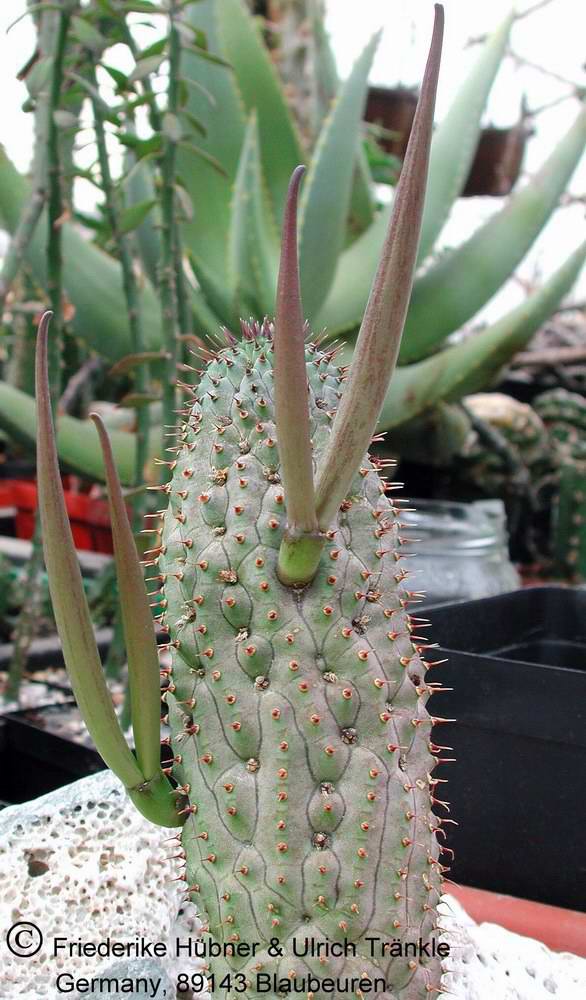
Spontaneous fruit set has not been documented, nor have hybrids. In favourable weather H. officinalis flowers without difficulty in two flushes, in early summer and late autumn, although it is only rarely very floriferous. The small flowers produce only a slight unpleasant odour.
As a medicinal plant, H. officinalis has been used in the treatment of haemorrhoids.
Following the revision of Hoodia and Lavrania by Bruyns (1993), the taxon was transferred from Trichocaulon to Hoodia sect. Trichocaulon.