Original description
Hoodia juttae Dinter, Neue Pfl. Südw.-Afr.: 34. 1914; also published later in Sukkulentenforschung 2: 91 (1928).
Description
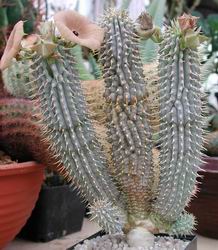
A richly branched shrub up to about 30 × 50 cm, usually branching from the base. The pale grey-green stems are upright and about 3–5 cm thick. The tubercles are arranged in 15–17 ribs and each ends in a pale grey-green spine.
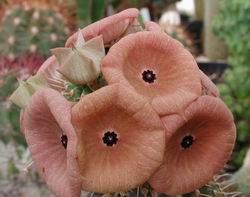
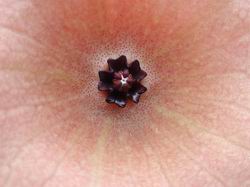
The flowers occur in groups of one to four and open successively in the upper part of the shoots. The corolla is broadly five-lobed, flesh-coloured to pale yellow-brown; the corona is dark blackish purple.
Distribution
The species is restricted to slopes and interior areas of the Little and Great Karas Mountains in southern Namibia.
Cultivation
Hoodia juttae prefers a purely mineral, loose and very free-draining substrate. Stagnant heat and full sun at high temperatures can cause shoot tips to dry out and scorch. Waterlogging and high humidity at low temperatures should likewise be avoided.
Re-rooting requires patience and is best carried out in quartz sand or similarly airy mineral substrates with careful, consistent watering. Overwintering at around 10 °C is possible. Propagation succeeds from seed; grafting has also been used successfully.
Notes
The species can become strongly branched over the years and is a persistent flowerer. Hand pollination is possible; spontaneous fruit set is not known from our collection.
Note: This page is an editorially condensed prototype based on the existing Asclepidarium species page. The complete original text, references and all illustrations can be incorporated during later migration.